The Northwest Fencing Guide: How to Fence for Wolves, Snow, and Dry Ground
If you've ever built a fence in the Pacific Northwest or the Mountain West and watched it heave out of the ground by spring, lose its charge in a dry August, or fail to turn a predator you never had to worry about a few states over — you already know the truth. Fencing in the Northwest is not like fencing anywhere else.
Wolves and grizzlies are part of the calculus here. So is snow load, deep frost, rocky volcanic soil, and ground so dry it barely carries a charge. The fence that works in the Midwest or the Southeast will quietly fail across Washington, Oregon, Idaho, Montana, and Wyoming — not because it was built poorly, but because it was built for the wrong country.
That's exactly why we created the free Northwest Fencing Guide. Below is a preview of what makes fencing this region different, and how to get it right the first time.
Why Fencing in the Northwest Is Different
Most fencing advice assumes one climate and one kind of soil. The Northwest has neither. A single mountain spine — the Cascades through Washington and Oregon, the Rockies through Idaho, Montana, and Wyoming — splits the region into three completely different worlds. Which side of that line your land sits on changes your posts, your wire, your coatings, and, most of all, how you ground an electric fence.
Three zones, three different fences
Wet west (coastal Washington and Oregon). Heavy rainfall, mild winters, and saturated soil. Grounding is easy here, but rot and corrosion are relentless — untreated posts fail, ungalvanized wire rusts, and connectors corrode at the joint. The fix is ground-contact-rated posts and heavily galvanized wire and hardware.
Mountain and snow country (high elevation across all five states). Deep frost and heavy snow load are the enemies. Corner and brace posts have to be set below the frost line or they'll heave loose, and the whole system has to be built to shed and survive snow weight through a short building season.
Dry east (eastern Washington and Oregon, southern Idaho, the plains of Montana and Wyoming). High-desert soil is dry, rocky, and a poor conductor. Posts hit rock, augers struggle, and — critically — an electric fence struggles to deliver a shock through soil that won't complete the circuit.
The Northwest Predator Problem
This is where the region truly earns its own fencing guide. The Northwest carries predators most of the country never has to plan for, and a fence built for coyotes won't stop them.
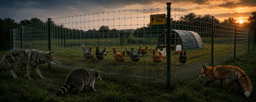
- Gray wolves are established and expanding across Idaho, Montana, Wyoming, and into eastern Washington and Oregon. Turning them takes multi-strand, high-joule electric fence, often paired with fladry, night penning, and guardian animals.
- Grizzly and black bears roam the Greater Yellowstone region and the Northern Continental Divide. The proven protection for hives, coops, feed, and calving grounds is a properly grounded electric fence delivering 5,000+ volts.
- Cougars range region-wide and jump well, so small stock needs tall fencing and a secure, roofed night enclosure.
- Coyotes remain the constant everywhere, beaten with electric netting, tight woven wire, and a buried apron.
The common thread: predator fences fail on voltage, not design. A hard, consistent hit is what teaches a wolf or bear to stay away — and that comes back to grounding.
Choosing the Right Fence for Your Livestock
The Northwest livestock mix shapes the fence. Cattle run across all five states and lean on high-tensile electric and barbed wire for big country. Sheep are huge in Idaho, Montana, Wyoming, and eastern Oregon, where predator pressure — not containment — is the number one concern. Horses need safe, visible fencing with no barbed wire. Goats demand tight woven wire with hot wires top and bottom. And llamas and alpacas, far more common here than in most regions, need solid field fence plus predator protection.
The rule of thumb: build for the most demanding animal and the worst predator on your place. A fence specced for sheep in wolf country will comfortably hold cattle, horses, and llamas too.
The #1 Mistake Northwest Fences Make: Grounding
An electric fence is only as good as its ground. The charge has to travel through the animal, into the soil, and back to the energizer's ground rods. East of the Cascades and all winter long, that return path is the weak link — dry and frozen soil barely conducts, so a fence that tests hot at the energizer delivers a weak shock at the far corner.
The fixes are specific: more ground rods (and longer ones) sited in the moistest soil you have, or a hot/ground-return system that doesn't depend on the soil at all. In snow country, that ground-return approach keeps the fence working when frozen ground quits. Get grounding right and everything else falls into place — which is why it's the section of the guide most worth reading twice.
What's Inside the Free Northwest Fencing Guide
The complete guide goes deeper on all of it, written specifically for Washington, Oregon, Idaho, Montana, and Wyoming:
- Climate & terrain — matching posts, wire, and coatings to your zone
- The predator map — what stops wolves, grizzlies, cougars, and coyotes
- Fencing by animal — the go-to system for cattle, sheep, horses, goats, llamas, and poultry
- Choosing your system — high-tensile, woven, netting, barbed, and coated wire compared
- Energizers & grounding — the dry-soil and snow fixes most installs miss
- Shipping — stocked and shipped from our warehouse in Caldwell, Idaho, right in the middle of the region
Frequently Asked Questions
What's the best fence for wolves in the Northwest? A multi-strand high-tensile electric fence running a high-joule charge is the proven foundation, often combined with fladry around calving and lambing grounds, night penning, and livestock guardian dogs. Consistent high voltage is what makes it work.
Why does my electric fence lose power in dry or frozen ground? Dry and frozen soil is a poor conductor, so the circuit can't complete through the ground. Add more and longer ground rods placed in the moistest soil available, or switch to a hot/ground-return system that doesn't rely on soil conductivity.
How deep should I set fence posts in frost country? Set corner and brace posts below your local frost line — often 3½ feet or more across much of Montana, Wyoming, Idaho, and the higher Cascades — to prevent frost heave from loosening them over winter.
Does Kencove ship fence supplies to the Northwest? Yes. We ship fence supplies across Washington, Oregon, Idaho, Montana, and Wyoming from our warehouse in Caldwell, Idaho, with fencing specialists available to size your system before you order.
Get Your Free Copy of the Northwest Fencing Guide
Whether you're fighting predators, building on both sides of the mountains, or just tired of a fence that fades every dry season, the free Northwest Fencing Guide will help you build it right the first time — for the country you actually have.
[Download the free Northwest Fencing Guide →]([your Northwest Fencing Guide landing page URL])
Stocked and shipped from Caldwell, Idaho. Questions? Talk to a Kencove fencing specialist at 1-800-KENCOVE.