Setting Up Rotational Grazing Fence: A Step-by-Step Guide for Southeast Cattle Farms
By Kencove Farm Fence Supplies | Ships from Eastman, Georgia
Rotational grazing is the single most impactful management change a Southeast cattle producer can make. It improves forage quality, builds soil health, reduces parasite loads, extends the grazing season, and — when done right — puts more pounds on cattle with less hay and less land. But none of it works without the right fencing.
The fence is what makes rotational grazing possible. It's what divides your pasture into paddocks, controls where cattle graze and when, and lets the land rest long enough to recover before the herd comes back. Get the fencing wrong and the whole system falls apart — cattle push through, paddock rotations collapse, and you're back to continuous grazing with extra posts in the ground.
This guide walks you through exactly how to set up a rotational grazing fence system for a Southeast cattle operation, from planning your paddock layout to choosing materials, installing the perimeter and subdivision fencing, and managing the system season by season.
Why Rotational Grazing Works Better in the Southeast
The Southeast has natural advantages for rotational grazing that producers in other regions don't enjoy. Understanding these advantages helps you design a fencing system that maximizes them.
Longer Growing Season
The Southeast's warm climate gives you 8–10 months of active forage growth compared to 5–6 months in the Midwest or Northeast. That means your paddocks recover faster after grazing, which allows shorter rest periods and tighter rotation cycles. In Georgia, Alabama, and Tennessee, well-managed pastures can support rotational grazing from March through November — and even into December in the Deep South.
This longer season means your fence system gets more use and delivers more value. A rotational setup that costs $3,000 to install but eliminates two months of hay feeding pays for itself faster in the Southeast than anywhere else in the country.
Forage Diversity
Southeast pastures typically support warm-season grasses (bermudagrass, bahiagrass) and cool-season grasses (fescue, ryegrass, clovers) in overlapping seasons. Rotational grazing lets you manage these differently — grazing bermuda paddocks harder in summer while resting fescue paddocks, then reversing in fall and winter. Your fence system needs to be flexible enough to accommodate this seasonal shift in grazing patterns.
Soil and Climate Considerations
The Southeast's red clay soils are generally excellent for fence post anchoring and electric fence grounding. However, the long growing season also means aggressive vegetation that can ground out electric fences if not managed. Summer heat and humidity put additional stress on materials. Your fence system needs to account for both — the soil works in your favor, but the vegetation and climate require ongoing attention.
Planning Your Paddock Layout
Before you buy a single post or roll of wire, you need a plan. The layout determines how many paddocks you'll have, how large each one is, where the lanes go, and where water access points are. All of this drives your fencing requirements.
How Many Paddocks?
The minimum for meaningful rotational grazing is 4–5 paddocks. This gives each paddock at least 3–4 weeks of rest between grazing periods. More paddocks means longer rest periods, better forage recovery, and more flexibility — but also more fence to build and more gates to manage.
For most Southeast cattle operations, 8–12 paddocks is the sweet spot. This allows 30–45 day rest periods during the growing season and gives you enough flexibility to adjust for weather, forage conditions, and seasonal changes. You can always subdivide further later — start with a number you can manage and expand as you get comfortable with the rotation.
Paddock Sizing
The size of each paddock depends on your herd size, forage productivity, and how long you want cattle in each paddock. A useful starting point for the Southeast:
Stocking density target: 30,000–50,000 lbs of cattle per acre during the grazing period. Yes, that sounds high — that's the point. High stock density for a short period (1–3 days) followed by a long rest (30–45 days) is what drives the forage and soil benefits.
Practical example: A 50-head cow-calf operation averaging 1,200 lbs per pair (60,000 lbs total) on 100 acres with 10 paddocks gives you 10-acre paddocks. At 60,000 lbs on 10 acres, you're at 6,000 lbs per acre — a moderate density that works well for getting started. As your forage improves, you can add more temporary subdivisions to increase density.
Water Access
Every paddock needs water access. This is often the most overlooked constraint in paddock layout design. Your options include permanent water points that paddocks are designed around (central water tanks with lanes radiating outward), pipeline systems that deliver water to each paddock, or portable water tanks moved with the herd.
Design your paddock layout around water first, then fit the fencing to it — not the other way around. The most common rotational grazing layout in the Southeast is a wagon wheel or pie-slice design with a central water point and paddocks radiating outward, connected by lanes.
Lanes
Lanes are the corridors cattle use to move between paddocks and to access water. They need to be fenced on both sides (typically with permanent fence) and wide enough for your herd to move through without bottlenecking. Eight to twelve feet is standard for cow-calf operations. Sixteen feet or wider for operations using ATVs or trucks.
Lanes are permanent infrastructure — build them with your perimeter fence, not your temporary subdivision fence. They'll see the most traffic and the most wear.
Plan It Before You Build It: Kencove Fencebuilder
Before you start buying materials, use Kencove's Fencebuilder to map out your entire system. Draw your fence lines directly on an aerial map of your property, add gates and energizers where you need them, and instantly see the exact materials and cost you'll need — before placing your order. It takes the guesswork out of planning and ensures you don't end up short on wire or over-ordering posts. It's free to use and works for everything from a simple perimeter to a full multi-paddock rotational layout.

Choosing Your Fence Materials
A rotational grazing system uses two types of fencing: permanent perimeter and subdivision fencing (which may be permanent, semi-permanent, or temporary). Each serves a different purpose and uses different materials.
Permanent Perimeter Fence
The perimeter fence is your property boundary or the outer edge of your total grazing area. It needs to be strong, durable, and reliable year-round. This is where you invest in quality.
High-tensile wire is the gold standard for Southeast cattle perimeters. It's stronger than barbed wire, requires less maintenance, handles heat expansion and contraction better, and lasts 30–40+ years with proper installation. A typical cattle perimeter uses 4–5 strands of 12.5-gauge high-tensile wire with alternating hot and ground wires.
Why high-tensile over barbed wire? In the Southeast specifically, high-tensile outperforms barbed wire for three reasons. First, it handles the extreme temperature swings (30°F winter mornings to 95°F summer afternoons) without the sag and tension loss that barbed wire experiences. Second, it requires far less maintenance — no retensioning, no splice repairs, no sagging wires to fix every spring. Third, it can be electrified, which means your perimeter fence is both a physical barrier and a psychological one.
Post spacing for high-tensile: 30–50 feet between line posts (compared to 10–15 feet for barbed wire). Fewer posts means faster installation and lower cost. Use treated wooden posts or heavy-duty T-posts. Corners and ends need braced wooden post assemblies.
Permanent Subdivision Fence
If you're building a fixed paddock layout that won't change, you can use permanent fencing for your interior subdivisions. This is simpler to manage day-to-day but less flexible.
1–2 strands of electrified high-tensile wire is the most common permanent subdivision for cattle. The cattle are already trained to respect electric fence from the perimeter, so you don't need a multi-strand physical barrier for interior divisions. One hot wire at nose height (36–42 inches) is often enough. Two wires (one at 24 inches, one at 42 inches) gives extra security.
This approach is dramatically cheaper per foot than a full perimeter fence. You're running one or two wires on widely spaced posts instead of four or five wires on close posts.
Temporary / Portable Subdivision Fence
This is where rotational grazing gets flexible. Portable fence lets you change your paddock layout as conditions change — making paddocks smaller during fast growth, larger during slow growth, or creating entirely new subdivisions as needed.
Polywire is the most common portable subdivision material. It's a braided plastic and stainless steel wire that's lightweight, easy to handle, and visible to cattle. You run it on step-in posts (lightweight plastic or fiberglass posts you push into the ground by hand) and power it from a portable energizer.
Polytape is wider than polywire (typically ½ inch to 1½ inches) and more visible. It's better for initial training when cattle are learning to respect electric fence, and for areas where visibility matters (near roads, near other livestock).
Reels are essential for managing polywire and polytape. A geared reel lets you wind up hundreds of feet of wire in minutes. Without reels, managing portable fence is miserable. With reels, it takes 10–15 minutes to take down and reset a temporary paddock division.
Energizers for Rotational Systems
Your energizer powers the entire system — both the permanent perimeter and the temporary subdivisions. For a rotational grazing setup, you often need two energizers: a primary unit for the permanent perimeter and a portable unit for the temporary subdivisions.
Primary energizer (perimeter): AC-powered if you have power available near the fence. Size it for the total length of your perimeter plus lane fencing. For most operations under 200 acres, a 2–6 joule energizer handles the permanent infrastructure.
Portable energizer (subdivisions): Solar or battery powered so it can go wherever the temporary fence goes. A 0.5–1.0 joule solar energizer handles most temporary subdivision needs. The Southeast's strong solar exposure means solar energizers perform well year-round.
Voltage targets for cattle: Minimum 3,000 volts on the fence at all times. Cattle learn quickly — most trained cattle will respect a fence reading 2,500+ volts. But vegetation contact, rain, and fence length all reduce delivered voltage, so size your energizer to deliver 4,000+ volts to give yourself margin.
Installation: Step by Step
Here's the practical process for installing a rotational grazing fence system, organized in the order you should build it.
Step 1: Install Corner and Brace Assemblies
Start with the corners and ends of your perimeter, plus any corners in your lane system. These are the structural foundation of everything else. Use minimum 5-inch diameter treated wooden posts, set 3–3.5 feet deep. H-brace assemblies with a horizontal brace rail and diagonal wire provide the rigidity needed to handle high-tensile wire tension.
Southeast tip: In red clay soil, let corner posts set for at least a week before tensioning wire. Clay shifts as it dries, and posts that seemed solid on installation day can loosen if wire is tensioned immediately. In sandy coastal soils, use concrete around corner posts.
Step 2: Set Line Posts
Drive line posts along your perimeter fence line and lane fencing. For high-tensile, you can space line posts 30–50 feet apart on straight runs — much wider than barbed wire. Use T-posts or treated wooden posts.
Southeast tip: During summer dry spells, Southeast clay turns rock-hard. Plan to set posts in spring or fall when soil moisture is moderate, or use a hydraulic post driver for T-posts. Don't try to hand-drive T-posts into baked clay — you'll bend them.
Step 3: Run Perimeter Wire
String your high-tensile wire on the perimeter. Start at one corner, run to the next, tension, and crimp. Use proper high-tensile crimps and tensioners — not barbed wire splices. High-tensile wire is springy and requires specific tools to handle safely.
Wire configuration for the Southeast: A 5-wire perimeter with alternating hot and ground wires works well. From the ground up: ground wire at 12 inches, hot wire at 22 inches, ground wire at 32 inches, hot wire at 42 inches, hot wire at 52 inches. This gives you two nose-height hot wires and proper grounding through the fence itself (important during dry spells when earth grounding weakens).
Step 4: Install the Perimeter Energizer
Mount your AC or solar energizer near the start of your perimeter fence. Connect the hot lead to the hot wires and the ground lead to both the ground wires and your ground rod system.
Ground rod installation: Drive at least 3 galvanized ground rods (6 feet each, spaced 10 feet apart) in the Southeast's clay soil. Clay provides excellent grounding when moist, but during summer dry spells, grounding can weaken. More ground rods and deeper rods help maintain performance through drought periods. Water the ground rod area during extended dry spells if your fence tester shows voltage dropping.
Step 5: Build Lane Fencing
Run your lane fencing as permanent high-tensile, matching the perimeter spec. Lane fencing takes the most daily abuse (cattle walking along it, rubbing against it, crowding through gates) so build it to the same standard as the perimeter.
Install gates at every point where a paddock meets a lane. Insulated gate handles with spring-loaded hooks work well for daily opening and closing. Make gates wide enough for your equipment — you'll want to get a tractor or truck into every paddock at some point.
Step 6: Install Permanent Subdivision Fencing (If Using)
If you're running permanent interior divisions, install them now. One or two strands of electrified high-tensile on T-posts at 40–50 foot spacing. Connect to the perimeter energizer through insulated wire or underground cable at gate crossings.
Step 7: Set Up Portable Subdivision System
If you're using temporary fencing for subdivisions (recommended for flexibility), set up your first temporary paddock:
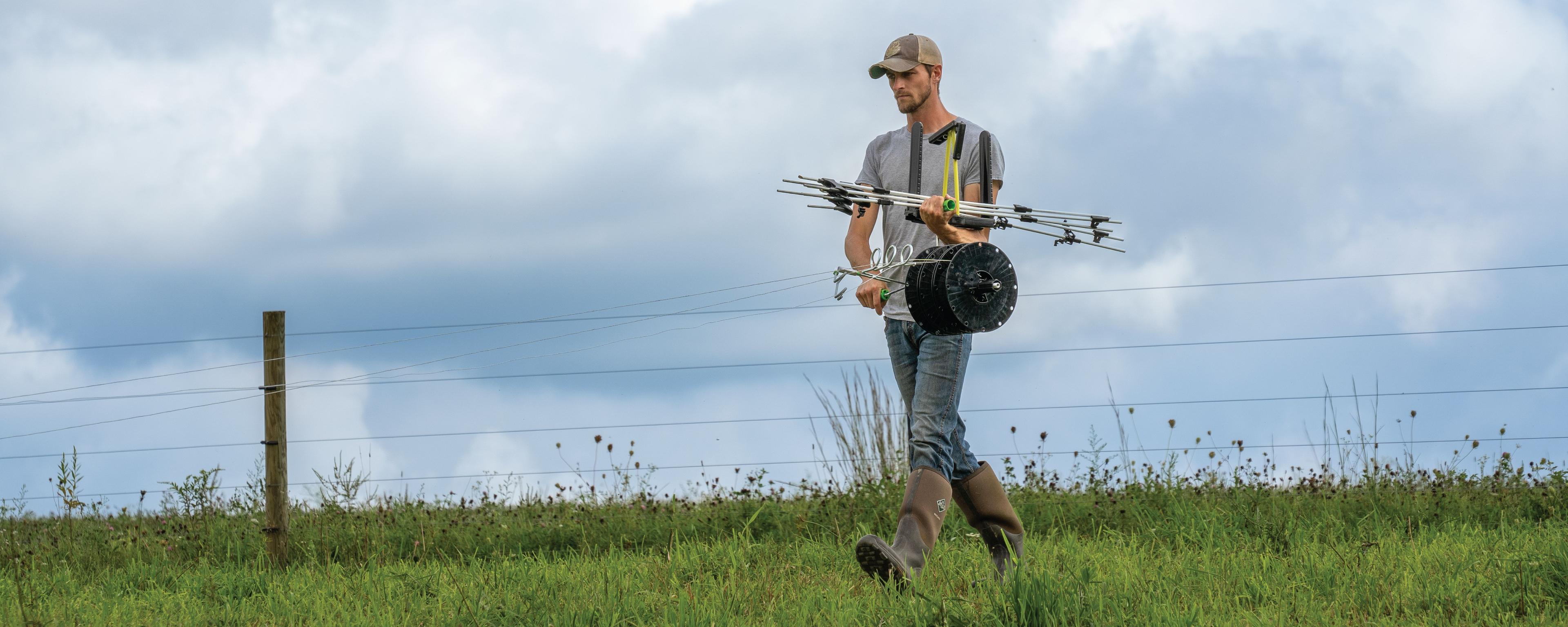
Gather your portable kit: Polywire or polytape on a geared reel, 20–30 step-in posts, a portable solar energizer, a ground rod, and a fence tester.
Walk your first subdivision line across the paddock. Push in step-in posts every 30–40 feet. Run the polywire through the post clips. At the far end, tie off to a permanent fence post or another step-in post.
Connect the portable energizer. Clip the hot lead to the polywire and the ground lead to a portable ground rod pushed into the soil. Turn it on and test with your fence tester — you want 3,000+ volts.
Train your cattle. If your cattle have never encountered electric fence, they need training before the system will work. Put them in a small area with a highly visible electric fence (use polytape for this initial training — it's easier for cattle to see). Let them discover the fence on their own. Most cattle learn in one or two contacts. Don't chase cattle into the fence — they'll associate the shock with being chased, not with the fence.
Managing the System Season by Season
Spring (March–May)
This is when your Southeast pastures explode with growth. Forage gets ahead of the cattle, and the temptation is to expand paddock sizes. Resist it. Instead, tighten your rotation — smaller paddocks, shorter grazing periods, longer rests. This forces cattle to graze evenly instead of spot-grazing the best patches and ignoring the rest.
Vegetation management on electric fence lines starts now. Mow or trim along permanent fence lines before growth gets into the wires. Check all connections, test voltage at multiple points, and replace any damaged insulators from winter.
Summer (June–September)
Peak heat and humidity. Forage growth slows in the hottest months (the "summer slump" for fescue-based pastures, though bermuda thrives). Adjust your rotation accordingly — longer rest periods, larger paddocks if forage is thin.
This is when vegetation grounding is at its worst. The combination of fast growth and afternoon thunderstorms means weeds and grass can ground out your fence lines within days. Walk your permanent fence lines weekly and clear any vegetation touching the wires. For temporary polywire, move it before vegetation grows into it.
Check your energizer output monthly. Summer is hardest on solar energizers — ironically not because of low sun, but because battery temperatures in direct sun can reduce performance. Keep solar panels clean and energizer units shaded if possible.
Fall (October–November)
The second growth flush. Cool-season grasses come back strong and warm-season grasses are still producing. This is your best opportunity to stockpile forage for winter. Use your temporary fence to close off paddocks and let forage accumulate height and density. Cattle graze the paddocks you allocate; the rest grow undisturbed.
This is also the ideal time for fence maintenance. Soil moisture is usually moderate, making it easy to reset any posts that have loosened. Test and repair all permanent fence before winter. Recharge or replace batteries in portable energizers.
Winter (December–February)
In the Deep South (Georgia, Alabama, Mississippi), you can graze through much of winter on stockpiled forage and cool-season annuals if your fencing system supports it. In the upper Southeast (Virginia, Tennessee, North Carolina mountains), you'll likely be feeding hay for 2–3 months.
Winter is when your rotational system pays off most visibly. A well-managed rotational system with stockpiled forage can reduce hay feeding by 30–60 days compared to continuous grazing. At $50–80 per round bale and 1–2 bales per day for a 50-head herd, that's $1,500–$9,600 in hay savings per winter. Your fencing investment pays for itself here.
Reduce grazing pressure during dormant months. Larger paddocks, longer stays, and sacrifice areas (one paddock you're willing to damage to protect the rest) preserve your pasture base for spring green-up.
What a Rotational Grazing Fence System Costs
Costs vary based on acreage, terrain, and how much of the system is permanent versus portable. Here are realistic estimates for Southeast installations.
Perimeter Fence (High-Tensile, 5-Wire)
| Item | Cost Per Foot |
|---|---|
| Wire (5 strands, 12.5 gauge high-tensile) | $0.25 – $0.40 |
| T-posts (every 30–50 ft) | $0.15 – $0.25 |
| Corner/brace assemblies (prorated) | $0.10 – $0.20 |
| Insulators and hardware | $0.05 – $0.10 |
| Total perimeter | $0.55 – $0.95 per foot |
For a 100-acre property with roughly 2,640 feet of perimeter, that's approximately $1,450–$2,500 in materials.
Permanent Subdivision Fence (1–2 Wire Electric)
| Item | Cost Per Foot |
|---|---|
| Wire (1–2 strands high-tensile) | $0.05 – $0.15 |
| T-posts (every 40–50 ft) | $0.10 – $0.15 |
| Insulators | $0.02 – $0.05 |
| Total subdivision | $0.17 – $0.35 per foot |
Portable Subdivision Kit
| Item | Estimated Cost |
|---|---|
| Polywire (1,320 ft roll) | $25 – $50 |
| Geared reel | $30 – $60 |
| Step-in posts (30 pack) | $40 – $70 |
| Portable solar energizer (0.5–1.0 joule) | $150 – $300 |
| Portable ground rod | $10 – $15 |
| Fence tester | $30 – $80 |
| Total portable kit | $285 – $575 |
Energizers
| Type | Cost |
|---|---|
| AC energizer, 2–6 joule (perimeter) | $150 – $400 |
| Solar energizer, 0.5–1.0 joule (portable) | $150 – $300 |
Total System Example
A 100-acre operation with high-tensile perimeter, lane fencing, 10 permanent subdivision paddocks, and one portable subdivision kit would typically cost $4,000–$8,000 in materials. Compare that to the $1,500–$9,600 per year in potential hay savings alone — most systems pay for themselves within one to two winters.
Common Mistakes to Avoid
Underpowered energizer. The most common mistake. A weak energizer teaches cattle they can push through. Cattle that have beaten an electric fence once are dramatically harder to contain with electric fence in the future. Always oversize.
Skipping the training period. Cattle need to learn what electric fence is before they'll respect a single polywire strand. Train them in a confined area with a visible, well-charged fence before you trust a temporary subdivision to hold them.
Too few ground rods. Poor grounding is the #1 cause of weak fences in the Southeast. Three rods minimum, six feet deep, ten feet apart. Test your ground by touching a voltmeter to the ground rod while loading the fence — you should read less than 400 volts on the ground rod. If it's higher, add more rods.
Not managing vegetation. Your 5,000-volt fence becomes a 500-volt fence when grass grows into the wires. In the Southeast's aggressive growing season, this can happen in a week. Build vegetation management into your rotation schedule, not as an afterthought.
Making paddocks too large. The benefits of rotational grazing come from high stock density and long rest periods. Thirty head grazing 30 acres for 30 days is continuous grazing with extra fence. Thirty head grazing 3 acres for 3 days with a 27-day rest is rotational grazing. The fence makes the difference.
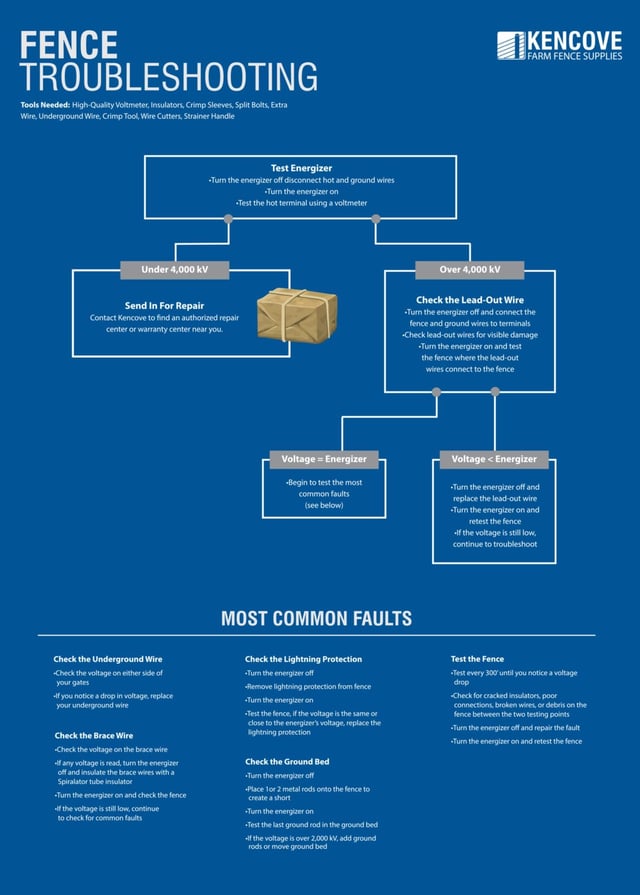
Not testing regularly. Buy a digital fence tester and use it weekly. Walk the fence. Check voltage at the far end of every run. A fence you don't test is a fence you can't trust.
Fast Shipping from Georgia
Kencove Farm Fence Supplies stocks everything you need for a rotational grazing system — high-tensile wire, T-posts, insulators, corner post hardware, polywire, polytape, geared reels, step-in posts, solar and AC energizers, ground rod kits, fence testers, and gate handles. We ship from our warehouse in Eastman, Georgia, so Southeast cattle producers get their materials fast.
Whether you're building your first rotational system on 50 acres or upgrading a 500-acre commercial operation, we can help you spec the right materials for your layout, your herd size, and your budget.
Need help planning your system? Call us. We've been helping cattle producers build better fences for over 40 years.
Kencove Farm Fence Supplies has been helping farmers and ranchers build better fences for over 40 years. We manufacture and stock high-tensile wire, electric fence, polywire, polytape, energizers, and all fencing accessories at our facilities in Pennsylvania and Eastman, Georgia.